liberTECHS

  • About
  • Contact
  • Portfolio
  • Home

Lead Generating AI Agent

Goal

To transform website visitors into qualified leads by capturing their business details, understanding their needs through advanced Natural Language Processing (NLP), and seamlessly scheduling discovery calls—all while providing an engaging, 24/7 customer experience that drives revenue and automates lead generation.

Role

As the lead developer, I designed and implemented a highly customizable, text-based, AI-enabled Customer Service Agent to optimize lead generation, streamline customer interactions, and automate discovery call scheduling. From crafting conversation flows to ensuring CRM integration, I built a solution that transforms website visitors into potential clients seamlessly.

  • Solution design and implementation. Architected and deployed an AI framework that captures visitor details, their business ‘pain points’ and integrates them directly into the CRM system for streamlined lead management.
  • Compliance. Ensured compliance with data privacy and protection regulations by implementing GDPR-compliant workflows.
  • Conversation flow optimization. Developed a user-friendly and polite conversational structure, ensuring clear, engaging interactions that encourage users to provide accurate and complete information.
  • Discovery call scheduling integration. Integrated a scheduling system that directs users to select discovery call slots via a business calendar view, creating a frictionless booking experience.
  • Custom styling. Styled the AI-enabled Customer Service Agent to match the website’s brand identity.
  • Data synchronization and automation. Automated workflows to ensure real-time updates between the AI Agent, CRM, and Google Workspace, eliminating manual processes and enhancing operational efficiency.

Capability

A highly customizable, AI-enabled Customer Service Agent designed to engage website visitors, capture their information, and convert them into qualified leads—saving time, boosting revenue, and enhancing customer satisfaction for the AI Agent owner.

  • Your new revenue. By delivering a seamless, NLP-driven interactions (natutal language processing), the Agent improves conversion rates, turning casual visitors into valuable business opportunities.
  • Your new time. Achieve more in less time. Or more time thanks to your consistently good, scalable and future-proofed customer service capability.
  • Cognition-driven conversations: Unlike basic bots, this NLP-powered AI Customer Service Agent engages in meaningful, context-aware dialogue, delivering intelligent and sensible interactions with your website visitors.
  • Lead generation automation. Captures essential details like name, email, phone number, business type and any pain points, automatically routing the information to the CRM for immediate follow-up.
  • Discovery call scheduling. Guides users to select a convenient time for a discovery call, fully automating the process to save time for both potential clients and the business owner.
  • 24/7 customer engagement. Offers a consistent and professional user experience, providing answers to FAQs and gathering leads around the clock without manual intervention.
  • Increased operational efficiency. Streamlines lead management with automated data collection and CRM integration, reducing manual workloads and ensuring accurate records.

Tech Stack

  • Compliance & Privacy: GDPR-compliant workflows and data protectin using Google Workspace
  • AI Agent Development & Conversation Flow Design: Botpress
  • Automation & Data Validation: Botpress intents, JavaScript
  • CRM Integration: Google Workspace, Custom CRM workflows
  • Front-End Integration & Styling: WordPress, JavaScript, CSS

Year

2024
Filed Under: Data Engineering & BI

AI Inbox Destressor

Goal

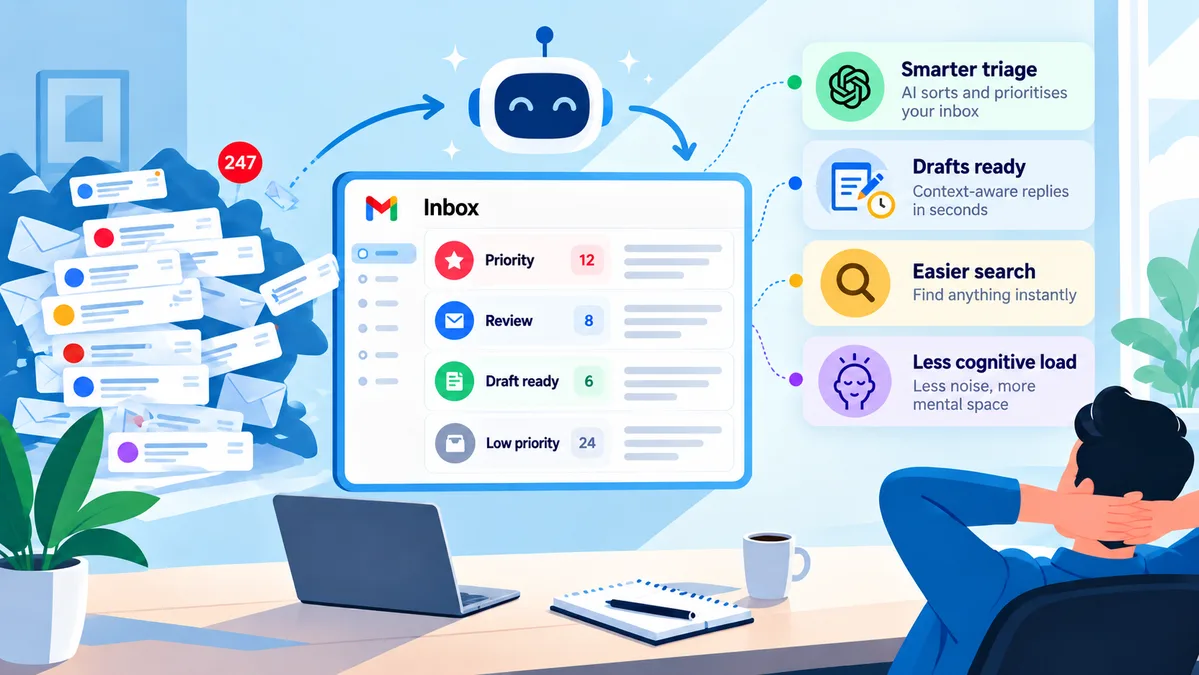
Reduce the mental overhead of email by turning a noisy inbox into a small number of clear, actionable decisions.

Traditional inbox management still requires repeatedly scanning messages, deciding what matters, remembering what needs attention and mentally tracking conversations that can wait. The objective was to remove as much of that work as possible while preserving confidence that important messages would not disappear into automation.

I designed a system that continuously reviews incoming email, understands conversations in context, separates genuine actions from noise and prepares useful replies where appropriate.

The aim was not to process more email. It was to make email require less attention.

Role

I designed, built and productionised the system end-to-end, combining deterministic workflow engineering with selective AI decision-making.

  • Solution architecture. Designed the end-to-end email triage and response workflow around a simple, low-friction user experience.
  • Pragmatic AI integration. Combined conventional automation with AI where interpretation or response generation added value, keeping the system predictable and controlled.
  • Context-aware drafting. Built automated reply preparation that uses the available conversation context while keeping final sending under human control.
  • Production reliability. Engineered the system for dependable recurring operation without duplicate work or continual manual cleanup.
  • Extensible design. Structured the solution so additional email use cases can be introduced without compromising the core experience.

Capability

The system continuously reduces inbox clutter into a smaller, organised set of actions, prepared responses and messages worth attention — helping email demand less time and mental energy.

Business Impact

  • Reduced inbox checking. Important email is surfaced automatically, reducing the need to repeatedly scan the inbox just to see whether something needs attention.
  • Clear priorities. Incoming email is organised into simple action states, making it immediately clearer what needs a response, review or no immediate attention.
  • Replies already waiting. Where enough context exists, useful reply drafts are prepared directly in the existing conversation, shortening the path from reading to responding.
  • Smaller decisions. When human input is needed, the system surfaces exactly what requires attention while preparing the rest of the response.
  • Less cognitive load. Low-priority messages are kept away from the active workload, reducing inbox noise and the feeling that everything needs attention.
  • Better inbox UX. Consistent organisation turns the inbox into a clearer action interface rather than an undifferentiated stream of messages.
  • Better searchability. Structured organisation makes past and current conversations easier to find without relying on remembering exact senders, subjects or keywords.
  • Nothing important silently disappears. Automation is deliberately conservative, keeping important or uncertain messages visible rather than aggressively filtering them away.
  • Human-controlled sending. Responses can be prepared automatically, while outbound email remains explicitly user-approved.
  • Reliable ongoing operation. The system is designed to run repeatedly without creating duplicate work or requiring continual manual cleanup.
  • Extensible automation. New email use cases can be added without redesigning the overall experience, allowing the system to evolve as requirements change.

Tech Stack

  • Email & Messaging: Gmail ecosystem
  • AI Layer: Large language model services
  • Automation Layer: Workflow orchestration and event-driven automation
  • Integration Layer: Email APIs and structured data interfaces
  • Decisioning: Deterministic rules combined with AI classification
  • State Management: Explicit workflow and conversation state
  • Development: JavaScript / Python
  • AI Engineering: Structured outputs, contextual classification, specialised prompting
  • Operations: Scheduled processing, error handling, idempotency and workflow observability

Year

2026

Filed Under: Apps & Websites, Data Engineering & BI

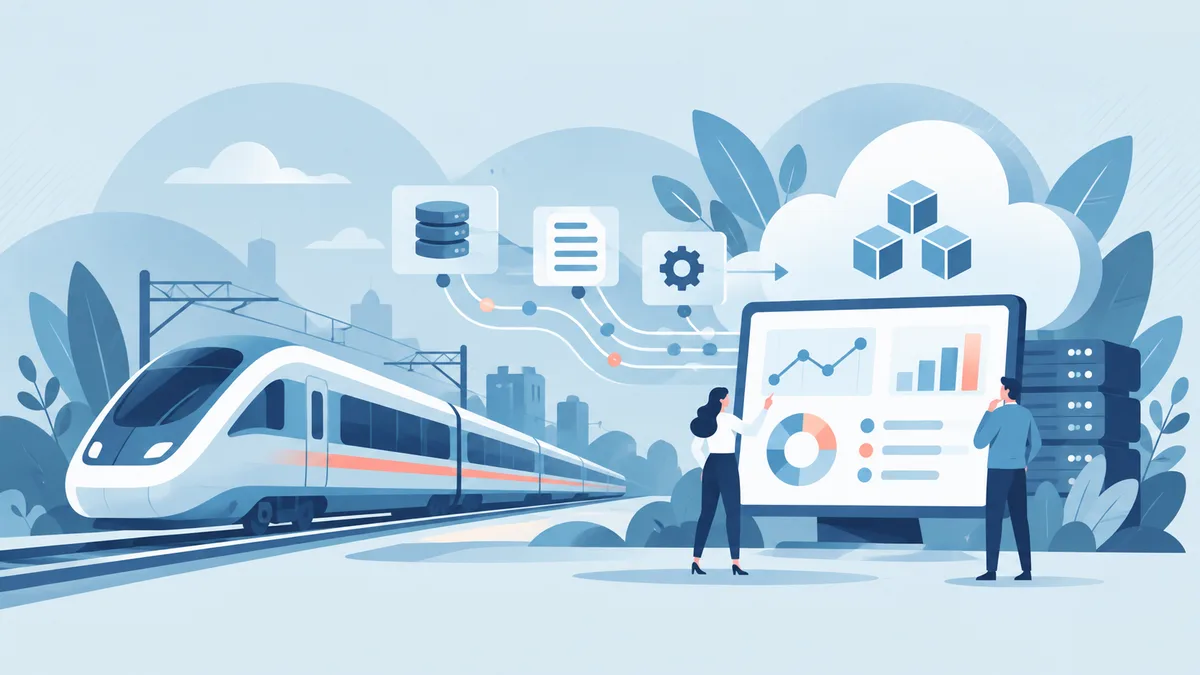
Business-Critical Rail Data Pipelines

Goal

Modernise business-critical rail data processing by replacing legacy desktop and manual workflows with reliable, scalable and governed AWS data pipelines.

The programme needed to move important operational datasets — including ticket sales, ticket scans, reservation availability, customer-experience feeds and delay-repay data — onto a centrally managed cloud platform without disrupting existing reporting or downstream consumers.

The objective was not simply to “move data to AWS”. It was to create production-ready data services that could be trusted, monitored, maintained and extended by the wider engineering team.

Role

As a Contract AWS Data Engineer, I designed, built, tested and operationalised production data pipelines across LNER’s AWS data platform.

My work covered the full delivery lifecycle: understanding existing business processes, analysing legacy outputs, designing cloud-native replacements, building ingestion and transformation logic, implementing data-quality controls, supporting user acceptance testing, deploying infrastructure and resolving production issues.

  • Legacy-to-cloud modernisation. Replaced Alteryx and manually operated data processes with automated AWS pipelines designed for central ownership, scalability and long-term maintainability.
  • Production data engineering. Built ingestion and transformation workflows across APIs, files and databases using Python, SQL, PySpark, AWS Glue, Lambda, Step Functions, S3, Athena and related AWS services.
  • Incremental and historical processing. Designed pipelines capable of processing new data incrementally while also handling large historical backfills and safely bringing legacy history into the same curated datasets.
  • Data quality and reconciliation. Implemented completeness, uniqueness, schema and business-rule validation so data problems were detected before reaching downstream users. Outputs were reconciled against existing processes during UAT to prove that the new platform could safely replace them.
  • Production reliability. Designed restartable processing, pagination and continuation behaviour, deterministic record keys, retries and operational controls so pipelines could recover safely from failures rather than requiring manual rebuilding.
  • Secure external data delivery. Built controlled outbound feeds to external partners using encryption, managed credentials and restricted cloud access rather than exposing internal data stores directly.
  • Infrastructure and deployment. Delivered cloud configuration and environments using Terraform/Terragrunt and CI/CD, supporting repeatable deployment across development, staging and production.
  • Stakeholder collaboration. Worked directly with engineers, analysts, data providers and business users to understand requirements, resolve discrepancies and turn existing operational processes into maintainable technical solutions.
  • Technical ownership and documentation. Produced detailed pipeline and operational documentation so systems could be understood, supported and extended after delivery.

The work ranged from straightforward scheduled extracts to complex multi-stage pipelines combining incremental APIs, historical data, transformation, quality controls and curated AWS data stores.

Capability

The resulting capability moved business-critical processing away from individually operated desktop workflows and into centrally managed cloud services.

Business Impact

  • Ticket scan data. Replaced a legacy Alteryx process with a governed AWS pipeline, giving teams a more reliable source for ticket-scan analysis and reporting. Historical migration covered 100+ million scan records.
  • Ticket sales data. Brought historical and ongoing ticket-sales data into one automated cloud pipeline, improving consistency for reporting and reconciliation while reducing reliance on manual processing.
  • Reservation and ticket availability. Replaced legacy reservation workflows with a cloud-based data service, giving the business more reliable visibility of seat and ticket availability across services, journeys and booking horizons.
  • Customer-experience punctuality feed. Automated the daily delivery of disrupted-train data into the customer-experience platform, supporting timely analysis of how disruption affects passenger experience and removing dependence on the legacy feed.
  • Delay Repay data delivery. Automated the daily flow of rail transaction data into Delay Repay processing, replacing repeated manual extraction with a faster, more reliable and controlled data feed.
  • Safer migration. Reconciled new cloud outputs against existing processes before cutover, reducing the risk of disrupting reporting or downstream users.
  • Better resilience. Built pipelines to recover safely from failures, rerun where needed and reduce manual intervention.
  • Stronger data quality. Embedded validation so incomplete, duplicate or invalid data could be caught before reaching analysts, reports or external consumers.
  • Easier future change. Replaced individually operated desktop workflows with centrally managed, documented cloud services that were easier to support and extend.

How

  • Scalable cloud processing. AWS-native services supported growing data volumes, historical backfills and recurring production workloads.
  • Built-in data quality. Completeness, uniqueness, schema and business-rule checks were embedded into processing.
  • Recoverable processing. Incremental state, deterministic keys and restartable workflows supported safe continuation after interrupted runs.
  • Secure data delivery. Encryption, AWS IAM, Secrets Manager and governed external delivery patterns protected business data.
  • Operational transparency. Logging, orchestration and documented run behaviour made failures easier to diagnose and recover.
  • Maintainable engineering. Infrastructure as Code, CI/CD and reusable platform patterns supported repeatable deployment across environments.
  • Controlled migration. Legacy outputs were reconciled against new AWS pipelines before production adoption.

Tech Stack

  • Programming & Data Engineering: Python, SQL, PySpark
  • AWS Data Processing: AWS Glue, Lambda, Step Functions
  • AWS Storage & Analytics: S3, Athena, Redshift
  • Data Lake Technologies: Apache Hudi, Parquet
  • Orchestration & Scheduling: AWS Step Functions, EventBridge
  • Security & Access: AWS IAM, Secrets Manager, Lake Formation
  • Infrastructure as Code: Terraform, Terragrunt
  • DevOps: Git, CI/CD, GitHub Actions
  • Data Integration: REST APIs, JDBC, CSV, JSON, Parquet, SFTP
  • Data Quality: Schema validation, completeness checks, uniqueness controls, reconciliation, deterministic record keys
  • Secure Delivery: PGP encryption, SSH/SFTP, cross-account AWS delivery
  • Collaboration & Delivery: Jira, Confluence, technical documentation, UAT and stakeholder reconciliation

Year

2026

Filed Under: Data Engineering & BI

Cloud Data Migration

Goal

Modernise and centralise data management for HM Courts & Tribunals Service (HMCTS), part of the UK Ministry of Justice. Support the migration of legacy data workloads to a cloud-based Strategic Data Platform (SDP), improving data accessibility, reliability and operational efficiency.

Role

  • Delivered cloud-based data migration and transformation: Developed and enhanced SQL and PySpark workflows in Azure Synapse Analytics, supporting the migration, transformation and consolidation of data into the HMCTS Strategic Data Platform.
  • Automated data processing and deployment: Developed CI/CD integration scripts supporting data loading, transformation, validation and writing to the target platform, improving the repeatability and maintainability of data engineering workflows.
  • Improved data accessibility and reduced maintenance costs: Contributed to the cloud migration initiative, achieving a 25% reduction in data access time and saving thousands of pounds in annual maintenance costs.

Capability

Cloud-based data engineering and modernisation enabled through:

  1. Data Accessibility: Made consolidated datasets more accessible for downstream analysis and reporting.
  2. Data Migration: Migrated and consolidated data from existing systems into a centralised cloud platform.
  3. Data Transformation: Developed SQL and PySpark notebooks in Azure Synapse to process, validate and prepare datasets for downstream analytics.
  4. Data Integration: Supported data ingestion and movement through Azure-based data services.
  5. Automation and Reliability: Used CI/CD practices to support repeatable data loading, validation and deployment.

Stack

  • Python / PySpark – Data processing and transformations
  • SQL – Data querying and transformation
  • Microsoft Azure
    • Azure Data Factory (ADF) – End-to-end data pipeline orchestration and integration.
    • Azure Databricks – Upstream data cleansing and PySpark-based data prep.
    • Azure Synapse Analytics – Downstream SQL and PySpark transformations and analytics.
  • CI/CD – Automated integration and deployment workflows
  • Git – Source control
  • Regular Expressions (Regex) – Text processing and data manipulation

Year

2023

Filed Under: Data Engineering & BI

De-Risked Public Sector Data

Goal

Future-proof public sector client’s data management processes (collection, sharing, use, storage and publication). Consolidate data assets from multiple source systems for analysts to gain better insights and enrich their analyses.

Role

  • Developed and optimized AWS-based ETL processes: Designed and implemented 5 AWS Lambda functions and multiple AWS Glue ETL jobs, enhancing data ingestion and processing efficiency. This resulted in a 30% reduction in data pipeline execution time by automating data mapping, data asset initialization, and data preparation workflows.
  • Implemented robust data sanitization and compliance measures: Enhanced data quality and regulatory compliance by debugging and extending AWS Glue ETL jobs to perform comprehensive data sanitization, personally identifiable information (PII) identification and redaction. This ensured all data handling adhered to GDPR standards, securing sensitive information across all datasets.
  • Streamlined data migration and documentation: Authored high-level and low-level design documents and testing plans to ensure clear, maintainable code and reliable data migration processes. Developed 25 custom scripts for efficient data migration into AWS PostgreSQL, facilitating the seamless transition of critical data assets with minimal downtime.

Capability

Data-driven decision-making and reporting enabled via custom built:

  1. Data Integration: Combined data from various sources into a unified data warehouse.
  2. Data Transformation: Standardised and sanitised data for consistency and accuracy.
  3. Data Accessibility: Provided a user-friendly interface for accessing and querying data.
  4. Reporting and Analytics: Enabled comprehensive reporting and analytics capabilities.

Stack

  • Python – coding language for data pipelines
  • SQL – DQL, DML, DDL
  • AWS Cloud Services
    • Aurora RDS – To host a data warehouse
    • Glue – for data pipelines
    • Lambda – serverless compute platform
    • Step Function – workflow orchestrator
    • S3 – cloud storage
    • Comprehend – Machine Learning powered, continuoulsy trained Natural Language Processing (NLP) service. Used to identify and redact the personally identifiable information (PII).
    • CodeCommit – for repository management
    • CloudShell – browser-based CLI environment
  • Apache Airflow – for orchestration of data pipelines using DAGs
  • Docker Engine / Desktop – to create containers for airflow environment and postgresql instance
  • DevOps – GitHub Actions, Terraform
  • Git – for repository management
  • Pycharm – IDE
  • Atlassian Toolset – Jira / Confluence
  • Sharepoint – content collaboration and workspace
  • Mural – content collaboration / design
  • Microsoft Visio – solution design

Year

2024

Filed Under: Data Engineering & BI

Knowledge Extraction With Spark

Goal

Derive meaningful insights and knowledge from large volumes of text data.

Role

I developed a python and spark based tools to recognise, process and summarise untructured text data.

Capability

Highly customisable toolkit for rapid and high quality exploration of text patterns:

  • Profile unstructured text data by recognizing and quantifying either all text strings or user-defined ones.
  • Capture context variations around text patterns of interest
  • Conduct semantic grouping at scale to enhance clarity regarding patterns in text and improve the accuracy of conclusions.
  • Produce analytics-ready summarized data.

Skills

Regex, Spark, Python, Big Data

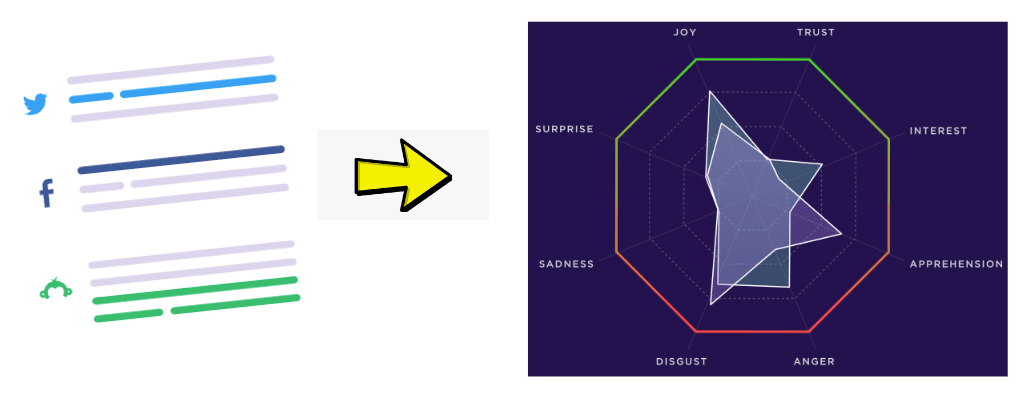
FROM:

Polluted + unnecessarily dilluted view of text patterns

TO:

Contextual focus + meaningful relative scale

Year

2022

Filed Under: Data Engineering & BI

Social Listening Data Pipelines

Goal

Client wanted to continuously quantify how the biggest and 200+ most polluting companies compare to each other (on the 0-100 scale) when it comes to their reputation + performance in causing less pollution + pro-activity in the space of general sustainability.

Role

  • Leveraged python OOP code across various tasks, reducing time-to-delivery by 60%. The code executes competitive benchmarking and sentiment analysis, thus improving the client’s campaign accuracy.
  • Co-developed python data pipelines for web crawling, ETL, data validation, and testing. To our client this serves as an extensive and efficient social listening system. The system scans corporate social media, annual reports for the 200+ companies, processes the data and feeds into the charts and KPIs at the front-end.
  • Quantified the reputation, sustainability and pollution reduction efforts across 200 target companies. Outcome was key in the acquisition of 2 new high-profile clients;

Capability

Multi-source and multi-keyword data pipelines driving sentiment analysis, competitive benchmarking and effective resource allocation in multinational advertising and public relations company.

Skills

Python (OOP) ; PyTest ; data pipelines building (Python + Luigi) ; Regular Expressions (Regex) ; Git ; Data validation (Great Expectations); Data ETL ; Web crawling (pages and apis) ; AWS S3

Year

2022

Filed Under: Data Engineering & BI

Web Scraper

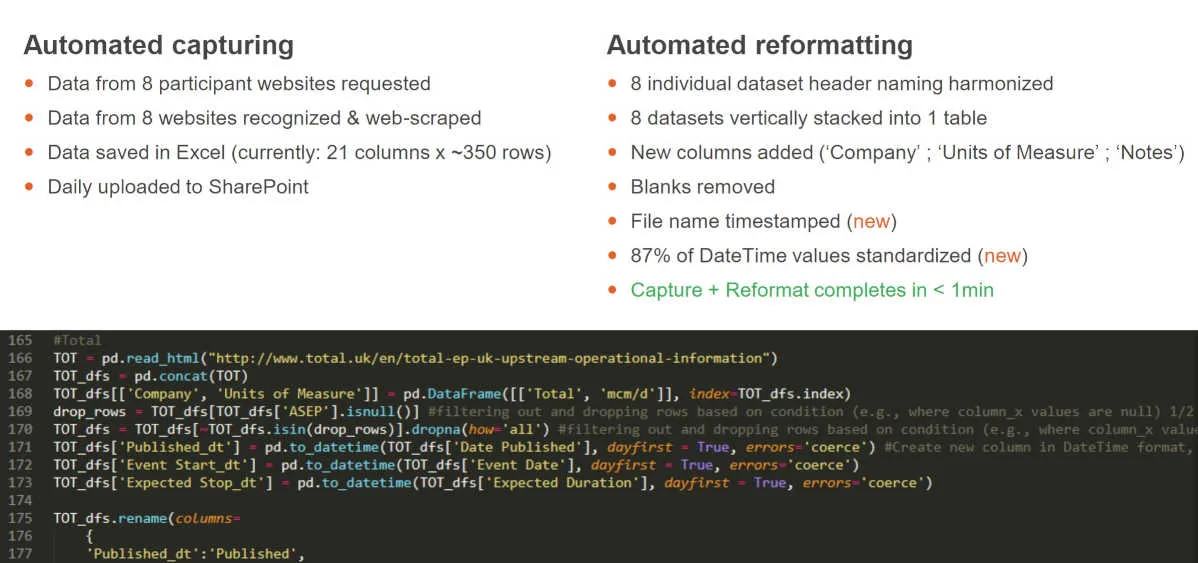
Data collection tool for producing accurate forecasts of the total supply in the UK’s natural gas market.

Goal

Client asked me to fix 3 resource drains:

  1. Time drain. Time consuming data collection.
  2. Money drain. Manually collected data was used in the natural gas demand forecasting process. Poor data quality and insufficient data collection frequency resulted in suboptimal forecasting results and significant revenue loss.
  3. Stress. Unlock new time for more rewarding work and reduce human stress.

Role

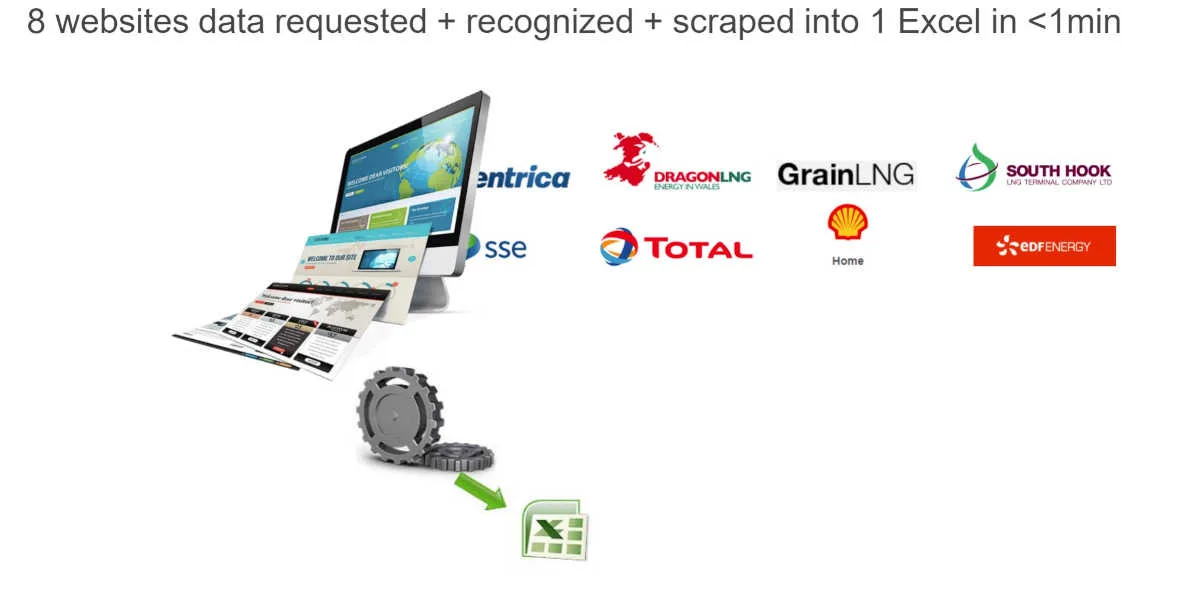
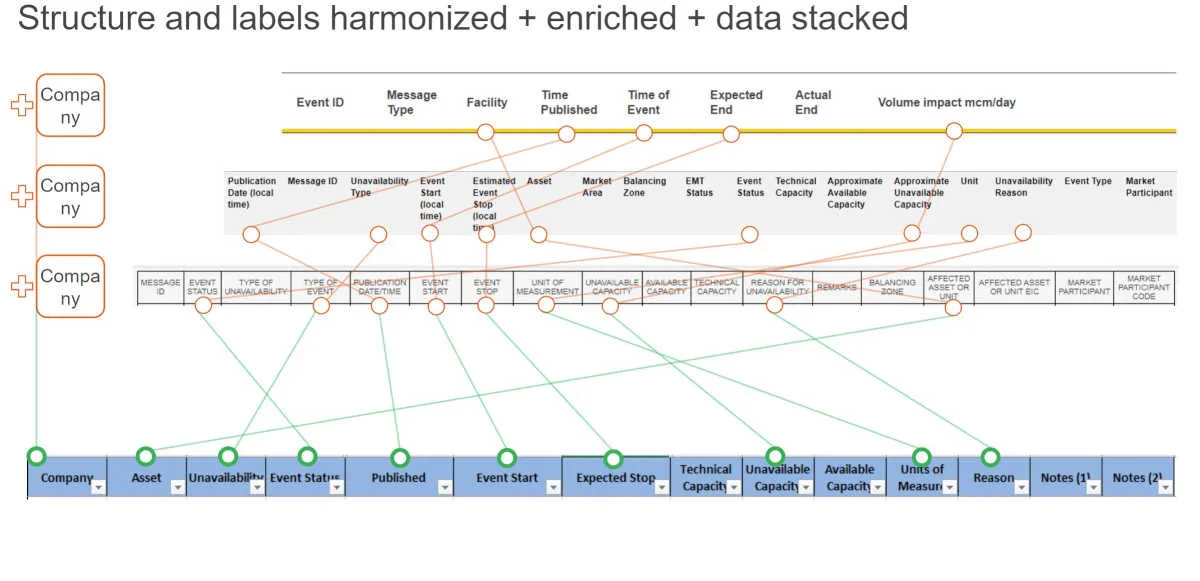
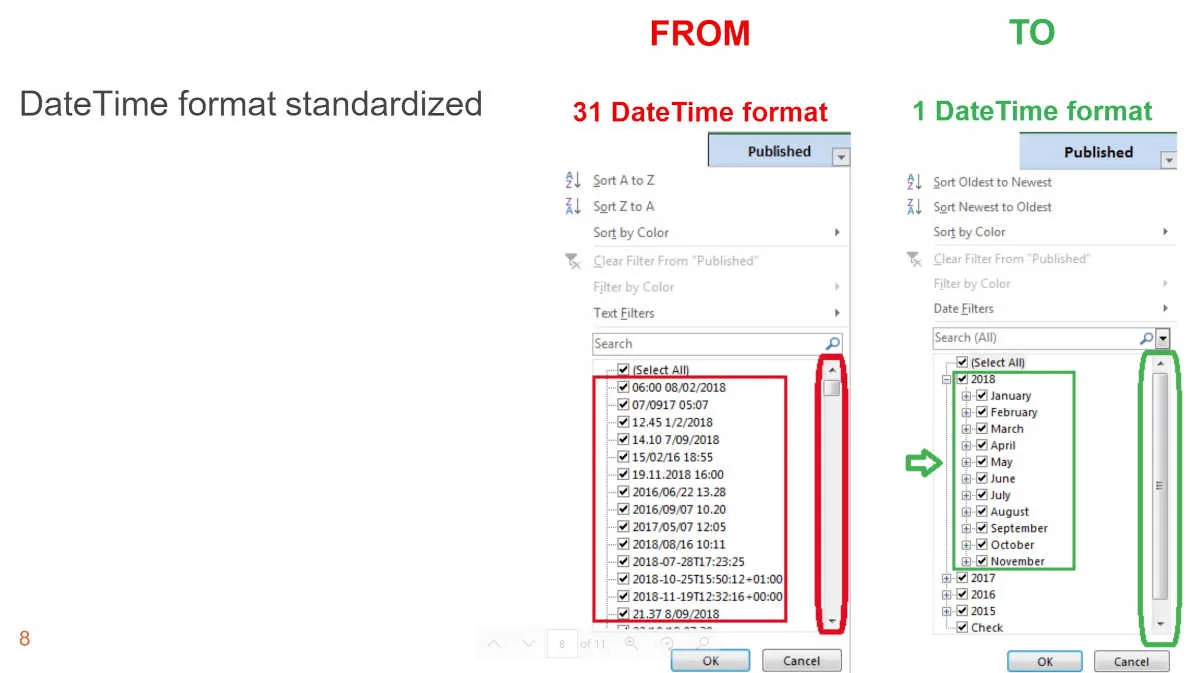
I automated tedious data processes with python (retrieval, harmonization, reformatting, sharing), saving 2 FTE hours per day, improving forecasting accuracy, maximizing company revenue, and creating more time for rewarding work.

Capability

I delivered 3 benefits for the client:

  1. Time gain. 2 hours (1 FTE equivalent) of time savings per day;
  2. Money gain. Better data quality, higher frequency and faster collection process significantly improved demand forecasting deliverables and protected key revenue stream.
  3. Reduced human stress. New time for more rewarding work unlocked / stress reduced.

Preview

Skills

Python, API development, Database design, Data pipelines, ETL, Web scraping, Data quality automation.

Year

2019

Filed Under: Data Engineering & BI

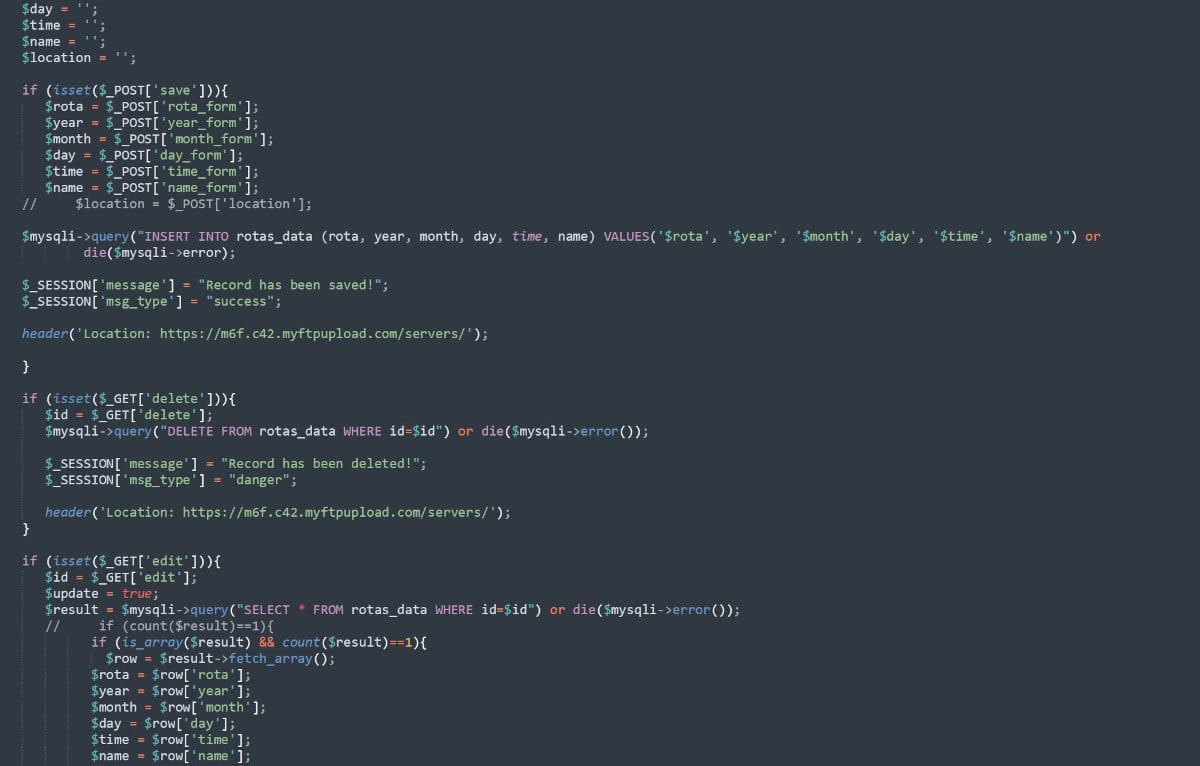
CRUD Operations

Goal

Enable local church community to self-manage rotas for a smooth mass service.

Role

I developed a CRUD app to handle create-read-update-delete operations on a community website.

Capability

A web app featuring:

  • functionality to create – read – update – delete rotas info
  • permissions

Skills

PHP, HTML5, CSS3, JavaScript

Year

2020

Filed Under: Apps & Websites, Data Engineering & BI

Bulk Downloader

Goal

Power reporting process to create a lot of visibility and impact + deliver time and money savings on production.

Role

I developed a python tool to automate tedious data process with python (retrieval + sharing) for the FTSE 100 company. This has boosted their reporting efficiency + unlocked new time for a more rewarding work.

Capability

Produces a user-friendly and comprehensive presentation to the top management. Python tool actions below for 100+ reports:

  • authenticates access to an in-house web-based system
  • opens necessary pages
  • downloads page contents as offline HTML files
  • uploads HTML files onto SharePoint site

Skills

Python, Microsoft SharePoint.

Year

2021

Filed Under: Data Engineering & BI

  • 1
  • 2
  • Next Page »

CONTACT

To get in touch, please fill out a contact form or give me a call at +44 7854 878 140.


SOCIALIZE

  • LinkedIn

JUMP TO

About
Portfolio
Home

© Copyright 2020 · LIBERTECHS · All Rights Reserved

We use cookies to ensure that we give you the best experience on our website. If you continue to use this site we will assume that you are happy with it.
You can revoke your consent any time using the Revoke consent button.